Since 2018, Sierrita operations has achieved Gold Tier certification from the Wildlife Habitat Council for its conservation and biodiversity in the community. The certification program is the only voluntary sustainability standard designed for broad-based biodiversity enhancement and conservation education on corporate lands.
Buffelgrass Management and Education in West Desert Trails
Buffelgrass is an invasive species present in the Sonoran Desert. It grows without restraint because it has no natural predators and outcompetes native species for food and nutrients, turning our biodiverse desert into a monocrop grassland.
The spread of buffelgrass provides fuel sources for fire amidst the desert landscape. Buffelgrass fills natural voids in the desert that act as fire breaks. Due to its high burning temperature of over 1400°F and the grass filling existing space, desert plants have no defense against these severe fires.
This is why human intervention is imperative to protect desert communities, flora and fauna. Freeport-McMoRan employees and local community members have been working together since 2018 to pull buffelgrass and fight back against invasive grasses. Get involved by joining our next community buffelgrass pull event, pulling buffelgrass on your own property and staying up to date on buffelgrass risks and controls.
In partnership with the Arizona-Sonora Desert Museum, Sierrita organizes volunteer events to manually remove invasive buffelgrass (Cenchrus ciliaris) from West Desert Trails. The museum provides educational information on the history of buffelgrass in Southern Arizona, the danger it poses to the native Sonoran Desert and how to identify and manage buffelgrass. From 2018 to 2021, Sierrita and community volunteers removed 35 acres of buffelgrass along the West Desert Trails with minimal regrowth. In 2022, Sierrita received the WHC’s Awareness and Community Engagement Project Award for the Buffelgrass Education and Outreach program.
If you are interested in joining us to protect biodiversity in the West Desert Trails, check back in to see when our next buffelgrass pull will be held.
Avian Nest Boxes in West Desert Trails
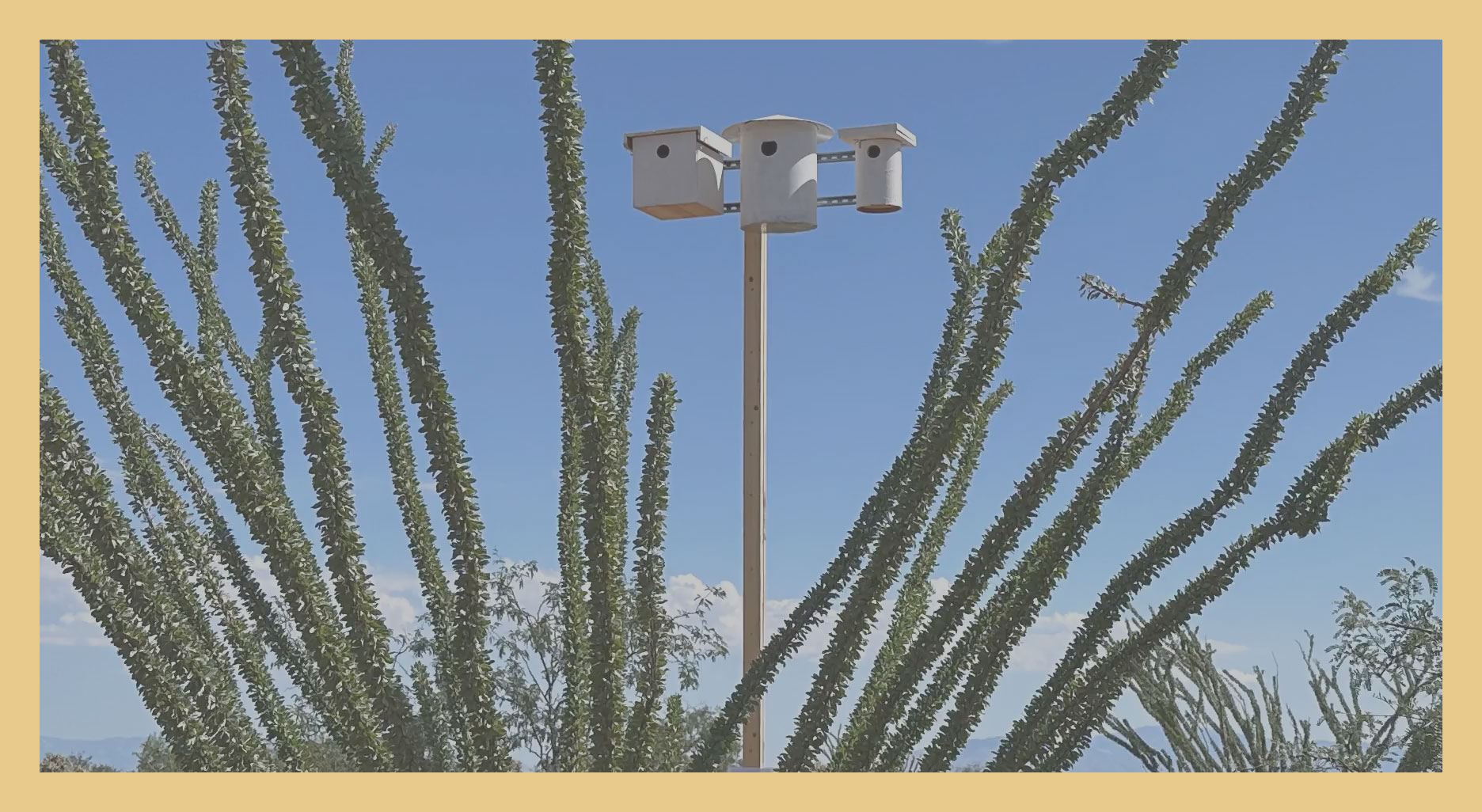
Sierrita has installed 98 nest boxes in West Desert Trails in partnership with Tucson Audubon Society. This project is part of Tucson Audubon’s broader research and conservation efforts to enhance nesting for multiple desert species such as the Lucy’s Warbler (Leiothlypis luciae), Western Screech Owl (Megascops kennicottii) and Ash-throated Flycatcher (Myiarchus cinerascens). Nest boxes are monitored in the spring and summer nesting season by Sierrita and community volunteers. Want to get involved? See our volunteer opportunities tab to see monitoring volunteer contact info.
We are excited to share that we have 59 Lucy’s Warbler boxes, 14 Western Screech Owl boxes, and 25 Ash-throated Flycatcher boxes.
Learn more about nest boxes for desert birds at Tucson Audubon Society (tucsonaudubon.org/nestboxes-for-desert-birds).
Native Agaves for Bat Habitat and Awareness
Sierrita has planted 210 native species of agave throughout the West Desert Trails in partnership with Bat Conservation International, Borderlands Restoration Network and other conservation non-profits. The multistakeholder Agave Restoration for Bats initiative aims to provide habitat and a food source for migratory bats such as the Lesser Long-nosed bat (Leptonycteris yerbabuenae) and the Mexican long-tongued bat (Cheoronycteris Mexicana). Bats are important pollinators and critical to the Sonoran Desert ecosystem. In 2022, Sierrita received the WHC’s Desert Project Award for the Agaves for Bats Habitat program.
Learn more about Agave Restoration for Bats at Bat Conservation International (batcon.org/our-work/protect-restore-landscapes/agave-restoration).
Sahuarita Middle School Pollinator and Rainwater Harvest Gardens
and Biodiversity / STEM Education Garden Club
In 2019, Sierrita worked with the Green Valley Gardeners organization to revitalize a small garden plot located at the Sahuarita Middle School (SMS). A native pollinator and cactus garden was installed and designed to collect stormwater runoff from adjacent impermeable surfaces. Sierrita has continued to aid with student outreach around pollinators and maintenance of this garden.
Sierrita also developed and presented biodiversity-related materials to students in the Garden Club, which included students in an after-school program. Pollinator garden maintenance and education was incorporated into the Garden Club monthly meetings.
In 2021, Sierrita partnered with Watershed Management Group to design and build a rain garden on a large empty portion of the Sahuarita Middle School campus. Sierrita employees as well as SMS educators, students and parents participated in the construction of the rain garden. This garden, which is comprised of native Sonora desert plants, harvests runoff from adjacent buildings and concrete surfaces to assist with stormwater management, create pollinator habitat and provide a large, attractive outdoor education space for student use.